Monday, November 27, 2006

THE HOSTILE HOSPITAL A Series of Unfortunate Events BOOK the Eighth by LEMONY SNICKET

I have finally figured out what I like about Lemony Snicket: He's the Douglas Adams of Children's Literature. It's true. He makes you laugh at the most basic of circumstances by giving them an in depth surreal explanation. For example the way he tries to explain why the book is not about him he says:


"But if this were a book about me, instead of about the three children who would soon run into someone they had hoped never to see again, I might pause for a moment and tell you about something I did many years ago that still troubles me. It was a necessary thing to do, but it was not a nice thing, and even now, I get a small quiver of shame in my stomach whenever I remember it. I might be doing something I enjoy--walking along the promenade deck of a ship, or looking through a telescope at the aurora borealis, or wandering into a bookstore and placing my books on the highest place in the shelf, so that no one will be tempted to buy and read them--when I will suddenly remember this thing I did, and think to myself, Was it really necessary? Was it absolutely necessary to steal that sugar bowl from Esmé Squalor?"


But this review is about the Baudelaire's unfortunate events. Especially what happened at the Heimlich (or Hostile) Hospital. In this book the events happening to the Baudelaire's change. No longer are they being dropped of at the home of some new caretaker that does not take care of them. At the end of the last book (The Vile Village) and the beginning of this one, the orphans are on the lam. They have run away from an angry mob that wants them burned at the stake for the murder of Count Omar/Olaf. Although we know it was Jacques Snicket that perished, and it was at the hads of Count Olaf not the orphans. The orphans try to send a telegram to Mr. Poe, but they get no answer and just as the Storekeeper finds out they are wanted for murder the children make an escape with the VFD van. They soon find out that this VFD is not the missing clue, instead it is the Volunteers Fighting Disease, whose idea of fighting disease is to give heart-shaped baloons to the sick folks at the hospital.


Once again I found myself laughing at the words of Sunny Baudelaire. As you may remember she is still a baby, but speaks non-sensical words in which only her siblings understand. In this one Sunny says her best word yet, "Pietrisycamollaviadelrechiotemexity" which means something along the lines of "I must admit I don't have the faintest idea of what is going on." I googled that word and the urban dictionary gives the following:


The state or condition of not having the faintest idea what's going on.


Donald Rumsfeld gave the president his daily briefing this morning. He began by saying: "Mr. President, yesterday three Brazilian soldiers were killed."


"OH NO!" the president exclaimed. "My God! That’s terrible!" His staff was stunned at this display of emotion, nervously watching as the president sat, head in hands.


Finally, the president looked up with pietrisycamollaviadelrechiotemexity and asked, "How many is a brazillion?"


Once again another great book for smart kids, and a fun book for everyone.

Wednesday, November 22, 2006

Free the Animals: The Untold Story of the U.S. Animal Liberation Front and its founder, "Valerie" by Ingrid Newkirk


How can a law abiding police officer become one of the most wanted Animal liberationists, sought by the FBI, Scotland Yard and many state police? This book tells the story of how the Animal Liberation Front (ALF)'s founder, "Valerie." Moved from a life fighting crime to a highly sought after fugitive.

After a police raid on a warehouse where experiments are perfomed on monkeys, "Valerie" sees the injustice in the treatment of experimental animals. The conditions of the facilities and the treatment of the animals as tools and not living creatures forces "Valerie" to seek out the ALF in Europe and begin training in what could almost follow the training of freedom fighters or even military covert operations.

Given the fake name of "Valerie" to protect her identity, we follow her through the training and into forming the U.S. ALF. This book takes the reader on several missions in which cruelly treated, dogs, kittens, monkeys, chimpanzees and more are liberated. At many times it reads as a spy novel when having to break into universities and other facilities performing many cruel experiments.

Not only do you get the thrill of a spy novel but the book also dishes out a heavy dose of realism in the unwarranted animal experimentation business. No matter what your view of animal experimentation I highly recommend you read this book. There are 2 things you can get out of it.

1. A great adventure story comparable to any war story or spy novel.

2. An insight to how animal experimentation does nothing to further the cause of science.

This book made a believer out of me.

Tuesday, November 21, 2006

Movie Review: The Night Listener


This is one of those Robin Williams art films. No funny guy routines here. Robin's character is Gabriel Noone a late night radio story teller who is running out of stories to tell.

Basically, Gabriel's relationship with his lover, Jess, portrayed by Bobby Cannavale, is crumbling. This after Jess is "recovering" from AIDS. The recovery part is not explained but apparantly now that he has more of his life back to live he wants to do it without Gabriel. The interesting part is that the bulk of Gabriel's career was to tell stories about how he was coping and helping his partner to cope with AIDS and the terminal view of life.

Enter Pete Logand (Rory Culkin/Toni Collette), a young boy who was sexually abused by his parents and has written a book about his life. A publisher gives Gabriel the book and Gabriel is astonished by the maturity of the author, and begins a "relationship" with the boy as two professional authors giving advice, and supporting Pete as he is dying from AIDS, contracted during his childhood. Pete has been adopted by his caseworker Donna Logand (Toni Collette) to get him away from the threat of his mother, who was one of his abusers and is wanted by police.

The idea that Pete and Donna are the same person comes from Jess who notices on the phone the voices sound the same. This starts the movement of the movie when Gabriel goes in search of Pete & Donna Logand, in a small town in Wisconsin.

At this point the mystery keeps on building and the creepiness begins. Many of the townspeople think that Gabriel may be one of the pedophiles coming back for Pete, and Donna seems to never be found.

If you are looking for a creepy, suspenseful and full of mystery and twists movie, check out The Night Listener.

One thing I have to say is that in the theater where I viewed this film there was one very "funny" response from an audience member. The theater had only about 10 people (other than me) and they were all well over 60. Throughout the film you knew Robin was portraying a homosexual and he and his lover even shared embraces. Also the movie dealt with a severe subject of pedophilia. But at the end of the movie Robin's character gets a kiss...actually more of a peck on the cheek...from the actor playing his lover. After all the other stuff in the movie. A little old lady saw this peck on the cheek and LOUDLY exclaimed her disgust saying, "oh that's just filthy."

I just wanted to slap her and say why did it take a LITTLE kiss to spark you into action...and you weren't bothered by any of the other stuff?....but I just left it alone.

Saturday, November 18, 2006

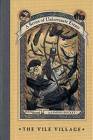
The Vile Village (A Series of Unfortunate Events, Book 7) by Lemony Snicket


Here we are again reliving the lives of the Baudelaires in yet another unfortunate circumstance, or rather a series of them. First of all the orphans have a new guardian. Actually, this time they have several of them. In this book we learn of the aphorism "It takes a village to raise a child." (I think Hilary would be proud.) So the orphans get to choose from several villages that have taken up the government's plea for villages to raise orphans. As the Baudelaires browse through the brochure to pick their village they find one with the name of "V.F.D." In past books it was learned that V.F.D. were the initials that stood for some secret about the death of the Baudelaires' parents and Count Olaf. Thinking this may lead to the answer to that clue the orphans pick V.F.D. as their new home.

The village, as it turns out, isn't so much interested in "raising" the children but having them do the village's chores. Also none of the villagers want to feed or house the orphans. So the town's handyman, Hector takes them in. VFD has many crows that roost at night in Nevermore Tree. The village also has many rules that are almost impossible to keep from breaking. Such as rule #67, which clearly states that, " no citizen is allowed to build or use any mechanical devices." or Rule #108 clearly states that "the V.F.D. library cannot contain any books that break any of the other rules. If someone in a book uses a mechanical device, for instance, that book is not allowed in the library." So even the rulebooks are not allowed in the library because they describe someone using tools. Hector, who was in charge of ridding the town of mechanical devices and tools has a great inventing studio and library now secretly kept in his barn. This helps the children to find some answers and to help the Quagmire triplets escape. Yes you heard right, the Quagmires escape...sorry about the spoiler.

One of the things I have found in this series of books is that you can judge the content and outcomes by the key phrases that are repeated throughout each book. In this volume the following phrase are used: "a bolt from the blue," "Entertaining a notion," and "Deus ex machina." So judging from those phrases you can see that the orphans have a very entertaining time. My favorite are the many Deus ex Machinas that appear.

By the way we are also introduced to another mysterious character, Jacques Snicket,(yes the author's brother). But he is murdered before he can reveal the secret of the orphan's parents. But he does have a tattoo of an eye on his ankle just like Count Olaf. Speaking of Count Olaf, his disguse as Detective Dupin is simply hilarious, especially the description of the clothes he wears. He's "Cool."

Once again, I highly recommend this book for all readers age 9 and up (yes even the adults will get a kick out of them. The books are all part of many education systems Accelerated Reader programs, so here's a fun way to get those kids reading.


Tuesday, November 14, 2006

David Bowie's Ex-Wife is a whiney bitch.

Book Review - Backstage Passes: Life on the Wild Side with David Bowie by Angela Bowie

Well Angie let me down. What I had hoped to be a deep insight into the life of David Bowie, turned out to be a dull boring bitchfest about how she should have gotten more attention.

Now don't get me wrong there were some interesting anecdotes and some talk about the whole David Bowie music scene. But Angie just seemed to want to flaunt all the affairs she had and then gripe about how David had so many affairs. The old pot and kettle simile fits here. She also went on to talk about the affairs between her and Mick Jagger and David and Mick. Seems either everyone wanted David or everyone wanted Mick, actually she talks like everyone wanted her.

I found the book very dull and hard to put up with the non-stop ego boosting and bitching. Don't bother with this one.

If you do know of a good biography on David Bowie, let me know.

Monday, November 13, 2006

Borat movie review with some defense of Borat included.

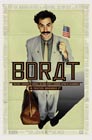
Borat: Cultural Learnings of America for Make Benefit Glorious Nation of Kazakhstan


Oh my gosh, my sides still hurt from watching this movie. At first when I sat down to write this review I was set to try and defend Sach Baron Cohen's choices. After all, he's getting sued by pretty much everyone that fell prey to this "mockumentary." When the folks realized it was a prank they said oops, but when revealing their true inner self when discussing their hatred toward homosexuals, foreigners and jews they were all ready and willing to discuss them openly.

With that said, I will simply review the movie and let you decide for yourself.

Basically the premise of this movie is that Borat, a journalist from Kazakhstan, sets out to learn what makes America a great country. The idea is that once he finds out he will bring this information back to Kazakhstan so they can be a great nation also.

So off he goes to New York. In New York he uses the flower garden of Trump Apartments as a toilet. Tries to kiss (an accepted form of greeting in Kazakhstan) folks on the subway. Offends a feminist group. (In Kazakhstan more than four women are not allowed to be toghether, unless it is a brothel or graveyard.) And falls in love with Pamela Anderson.

With Pamela in his heart he heads to California. Along the way he disrupts a local TV broadcast, learns to be a "homie," tells a group of rednecks his country supports this "war of terror," and finds out how real rednecks feel about homosexuals. He also learns what is the best gun to "kill a jew."

Let me tell you this is all hilarious in that folks fall for the prank and think he is for real. It really can show how we can be gullible and yet ready to reveal our innermost secrets to someone that seems harmless.

So let me once say in defense of the movie the following:
First of all Sacha Cohen is himself Jewish and is satirizing anti-semitism and actually bringing more attention to it.
The News person that scheduled "Borat" to be interviewed and is now sueing because she says she lost her job, it seems to me it was a good thing that a producer got fired for not researching a guest. I know in radio it is number 1 rule.
Finally, all those that got duped, why are you upset? Because your true nature got revealed? So?!?!?

I'm not sure where you are but my favorite theater is still showing Borat:
http://www.eagletheater.net

At first you may say "What do I care?"

Companies that abuse animals have convinced a small group of politicians to introduce a bill called the Animal
Enterprise Terrorism Act, which would allow the government to
charge animal rights activists with massive fines and jail time
for using nonviolent tactics. Please click this link, write to
your member of Congress, and ask him or her to vote "No" on this
unconstitutional bill.

http://getactive.peta.org/campaign/aeta_house_activist?rk=wdwpGL61GmIRW>

Now get past the idea that YOU may not care about animals. Or maybe you support vivisection. Any American citizen should look at this and ask, "Isn't this against the constitution?"
Yes they are trying to create a law to bypass 2 of the Amendments to the Constitution . First you have the right to protest peacefully.

Amendment I

Congress shall make no law respecting an establishment of religion, or prohibiting the free exercise thereof; or abridging the freedom of speech, or of the press; or the right of the people peaceably to assemble, and to petition the government for a redress of grievances.

Next there is:

Amendment XIV

Section 1. All persons born or naturalized in the United States, and subject to the jurisdiction thereof, are citizens of the United States and of the state wherein they reside. No state shall make or enforce any law which shall abridge the privileges or immunities of citizens of the United States; nor shall any state deprive any person of life, liberty, or property, without due process of law; nor deny to any person within its jurisdiction the equal protection of the laws.


Now this will create a little "catch-22" if someone tries to enforce it. But if they are trying to take away the right to protest vivisection. What's next we cannot protest the war? We cannot peacefully assemble and talk bad about the president? A lot of comedians will be out of a job there.

But seriously Americans have the right. And now big business is fighting to take away that right.

Remember it is "We the people."

Thursday, November 09, 2006

The Ersatz Elevator (A Series of Unfortunate Events, Book 6) by Lemony Snicket

Ahhh, here we go book six and well, simply put, things just keep getting worse for the Baudelaire orphans. This time around they are sent to a very "IN" part of town to live with their new guardians, Jerome and Esme Squalor, at 667 Dark Avenue in the penthouse apartment, on either the 48th or 84th floor. (Here's a spoiler, it actually turns out to be the 66th floor, the average of the 2).

The Squalors are very snooty people who only desire what is "IN." When the orphans arrive at the building they find that darkness is in and elevators are out. So not only do they have to climb the stairs, to what is later learned to be the 66th floor, but they have to do so in darkness. Upon arrival we find out that Esme Squalor is the 6th most important financial advisor and is only interested in the orphans because orphans are now in. Jerome is the one that takes an interest in the children and is pleased to have them around. But, he is kept busy by Esme who is getting ready for the "In Auction" in which all things "In" will be auctioned and the money will go to her bank account. So they all sip aqueous martinis (water with an olive in it) and talk about in things, like pin-striped suits.

Once again Count Olaf makes his entrance into the 71 bedroom (and many other types of rooms) apartment, but he's an invited guest. Invited under the guise of Gunther the In Auctioneer. In discovering what Olaf's plan is we learn what the word ersatz means. That is one thing I like about Lemony Snicket, he has a way of having the reader learn something without really knowing.

This book has many comic relief moments. This time most of them take the form of the words uttered by Sunny Baudelaire the baby that is no larger than a salami. In previous books Sunny only spoke in nonsensical syllables. In this book, however, her syllables start to make sense. Typically Sunny says words like; ayjim, puictiw and chittol, but every once in a while her dialogue is sprinkled with words that make sense. My favorite is when the orphans all go and try to find something to use as a rope to climb down an elevator shaft. (Ignore the previous sentence if you don't like spoilers.) Klaus comes back with curtian cords, Violet comes back with extension cords and each describe the item they found. Sunny offers up an armful of Jerome's neckties and says, "Armani." I found myself laughing out loud to that one.

Another thing I should mention is that the Quagmire triplets are still missing. At least for a little while. The Baudelaire orphans find the Quagmires and attempt a rescue. But alas, it fails and Olaf gets away. That doesn't really give anything away, after all the end is not the goal in these books. The journey is what makes Lemony Snicket's books worth reading.


Saturday, November 04, 2006

Book Review - "A Series of Unfortunate Events: BOOK the Fifth THE AUSTERE ACADEMY by LEMONY SNICKET

Once again we enter into another book in the unfortunate lives of the Baudelaire orphans. And again the children are left with a caretaker that just doesn't seem to care for children. It makes you wonder just how do these kids survive. I can tell you that it is Violet's inventing skills, Klaus' research skills and Sunny's bithing skills help them survive this book. However, in this book, the Baudelaire orphans get help from another group of orphans, the Quagmire triplets, Duncan and Isadora. Yes I'm aware that that's only 2 names, it seems unfortunate events also follow the Quagmire orphans. They lost their parents and their brother in a mysterious fire, not unlike the Baudelaire orphans.

Now at first you may think the orphans becoming friends is a good thing. The problem is that is the only good thing that happens to the Baudelaire orphans in this book. From the beginning their woes abound. First the orphans are dropped of at Prufrock Prep. boarding school where vice-principal Nero is in charge and whose only interest is practicing the violin. There is no worse sound than someone that doesn't know how to play violin insisting upon doing so. V.P. Nero also has some really strict rules such as; no student should be in the administrative building - if this happens the student(s) do not get silverware for their meals. If a student misses a class they get no drinking glasses and must have their beverages served in puddles on their trays. And the worst rule of all, if a student misses the nightly 6 hour violin concert they have to buy V.P. Nero a bag of candy and watch him eat it.

On top of all this the school itself is ominous. All the buildings are shaped like tombstones and the school's motto is: "Memento Mori" which means "Remember You Will Die." The Dorms all have a huge living room with a brick fireplace, a game room, and a large lending library, unfortunately the Baudelaires must have a permission slip with the signature of a parent or guardian. The parents are dead, and their guardians have either been killed or have fired them so they have to stay in shack dubbed "The Orphan Shack." This shack is infested with crabs and a tan fungus that drips from the ceilings.

So with all these unfortunate events you'd think it can't get any worse, but alas, Count Olaf appears again. He has a devious plan to capture the orphans. I will give you a hint though, he does succeed in caputuring the orphans and making off with them. You'll have to read the book to find more.

If you are a homeschooler or you have children age 9-17 these are great books. If you like to have fun reading, I can tell you I have had a blast reading these books. Now on to book 6 "The Ersatz Elevator"


Thursday, November 02, 2006

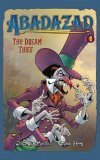
Book Review: "Abadazad: The Dream Thief - Book #2" by J.M. DeMatteis & Mike Ploog(Illustrator)

Once again I will tell you the next series of young pop fiction has started, and it is found in the form of Abadazad. Like Chronicles of Narnia, Harry Potter or The Series of Unfortunate Events, Abadazad is a series of books that will keep our youth interested in reading. With the Harry Potter series ending soon and Lemony Snicket having written "The End" of the Series of Unfortunate events. The next book craze void is needing to be filled. Abadazad will do that not only because of a really good story line but also because Abadazad uses the combination of chapter book with comic book.

In book 2 "The Dream Thief," Kate is in the magical land of Abadazad and has found out that her brother who was abducted 5 years past is still alive. Unfortunately he is "imprisoned" by the Lanky Man a.k.a. the Dream Thief. The Lanky Man has many children imprisoned in a contraption used to keep them asleep so he can harvest their dreams to power his machine. The purpose of the machine is not yet revealed but it does have something to do with the destroying of Abadazad. The 3 eyed Queen Ija has told Kate she will help find Kate's brother Matt.

This book introduces a few more of the magical characters in Abadazad. Auntie Nott, who is invisible, she became that way because she was so shy she avoided everyone and eventually turned invisible. There is Master Wix, the boy-candle. Yes he's a little boy that is made of wax. And there is the Waterlogged Wizard who lives in the 8 oceans of Abadazad whe helps Kate get Started on her journey.

The combination of chapter book and comic book helps to make this book come alive along with keeping the reader interested in the story. And with the creative story-line each book leaves you anxious for the next installment. The problem is now I have to wait until March 2007 for book 3.


Wednesday, November 01, 2006

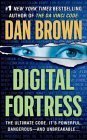
Book Review: "Digital Fortress" by Dan Brown

In rounding out my Dan Brown reading there was only 1 of the 4 novels I hadn't read. But now I have and I wish I would have read this one first. That way I wouldn't have been let down. "Digital Fortress" doesn't to have the edge or the constant action found in "The DaVinci Code" or even "Angels & Demons." It's not a bad novel, it's just very tame when compared to those action thrillers.

In "Digital Fortress" Dan Brown covers a very timely storyline, in which the U.S. Intelligence community relies on the NSA. And the NSA Relies on a new computer called TRANSLTR, which can snoop and read every email and break any encryption code. Published at least 5 years before President Bush had problems with wiretapping and snooping, Mr. Brown was talking about how the government could snoop through your e-mails. The action begins when a former NSA employee a computer expert, Ensei Tankado, who helped design TRANSLTR, does not think the government has the right to snoop in private lives of citizens and vows to make an unbreakable encryption code.

The code is Digital Fortress, and after creating the code the creator, Tankado dies of a heart attack, but not before putting the code up on the internet. The NSA has downloaded the code to try to break it but problems erupt without the key to the encryption code. Tankado's motto, "Who will guard the guards" is moved on through the fact that unless the NSA publicly admits to having TRANSLTR the code will destry TRANSLTR.

The action of this book is lacking mainly because most of the events take place in the Crypto-Dome of the NSA (home of TRANSLTR). However, Dan Brown, does do his signature globe hopping, by the NSA having to send the fiance (David Becker) of one of it's crypto agents (Susan Fletcher), to Spain to find the key which is with Tankado's body. At least that's where it started. So between the events in the crypto-dome and David Becker trying to locate a ring that Tankado handed off to tourists at the time of his death, the action just doesn't match up to Mr. Brown's other books.

It is a good espionage, plot-twister novel. Just don't compare to other Dan Brown books.


Tuesday, October 31, 2006

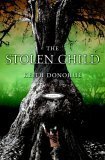
Book Review: "The Stolen Child" by Keith Donohue


The Stolen Child is one of those books that's hard to categorize.  While it's a coming of age story it has a bit of a twist.  The twist being the mixing of the mythos of faeries,hobgoblins and changelings.  Keith Donohue got the inspiration for this book from the Poem of the same name by William Butler Yeats, in which a child is lured away from home and into the woods by a changeling.

In Donohue's book he asks the question, "What happens next?"  "The Stolen Child" is about a young boy named Henry Day who runs away from home and is taken by the changelings.  Now the myth of the changelings is that a changeling takes the place of the young child abducted and in this case Henry Day is replaced by a changeling and Henry becomes a changeling.

That is just where the story begins.  The rest of the book follows both versions of Henry Day (the changeling/hobgoblin version changes his name to Aniday). The "now human" version grows up to be a piano virtuoso, because of a past he had before becoming a changeling. The changeling version learns to accept his life as a changeling but always wondering what his life would have been and missing his family.  While the "now human" version is constantly seeking information on his past life.

Both versions fall in love and seek their pasts while one loses his love the human form gets married and has a son and worries about the son being taken by changelings.  The soul searching through this book never seeks an apology for what has been done but rather, an acceptance and moving on of lives.  

It was purely concidental that I read this book around halloween, but while reading I did keep an eye on my son and one over my shoulder.  This book is beautifully written, poignant at times and with some humor thrown in.  A very good read that could easily become a classic.

Saturday, October 21, 2006

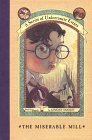
Book Review: THE MISERABLE MILL. A Series of Unfortunate Events BOOK the fourth by LEMONY SNICKET

Once again we join Violet, Klaus, and Sunny Baudelaire, otherwise known as the Baudelaire orphans and heirs to the Baudelaire fortune. But this book is a little different from the other three, at least 2 of the 3. In 2 of the last 3 books the orphans started out with some family member (usually very distant family) and a nice home, somewhat. Well in this book the orphans are dropped off at a train station at Paltryville and told to find their new caretaker, the owner of Lucky Smells Lumber Mill. Upon arrival at said mill they are told they will work at the mill (even though they are only children) and in return their new caretaker, Sir, will not allow Count Olaf to get to them.

Their new custodian, Sir, by the way, is called Sir because "No one could pronounce the name anyway." Also his head is in a constant haze of cigar smoke so you never see his face. He pays his employees in coupons, such as buy one snow shovel get one free and is constantly reminding everyone (including his partner) that he is "The Boss" because that's what the plaque says on his desk.

This book to me seemed to be difficult to get through, and I think that is due to the fact that we don't hear from Count Olaf or his minions until 3/4 of the way through the book. At least we don't think we hear from him. But as any Lemony Snicket reader will know, he is lurking in the background.

The continued sarcasm and wit of the Author, Lemony Snicket, is even more prevalent in this book. Especially once the orphans find out where Count Olaf is hiding. At this point it becomes a serious page turner with some wonderful comic relief. Once again, though, there is no happy ending just a continued, and maybe even more so, series of unfortunate events.

Thursday, October 19, 2006

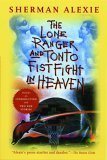
Book Review: The Lone Ranger and Tonto Fistfight in Heaven by Sherman Alexie

When I sat down to write out this review, the only thing I could say was "Wow!" Sherman Alexie first of all has a great style and can captivate you with his words alone. I would love to sit and talk with him for about 100 years. Then take another 100 years to sit back and absorb it all in. Not only does he have the great command of language but he also has a great insight into telling the stories from "the Rez." I read the updated version of the book published in 2005. This version has an intro by the author and 2 bonus stories. The original was published in 1993.

I was attracted to the book after watching the movie "Smoke Signals" which is based on the stories in this book. I was so pleased to find the stories that reminded me of the movie but even more so to find extra. Not only are these stories of life of Indians, for the politically correct, Native or Indigenous Americans, but they are also little lessons anyone can relate to. Also there are more than just stories there are "non-rhyming" narrative poems. Mr. Alexie draws great pictures with these.

Every story or poem will make you laugh a little and make you cry a little each time. I have chosen a couple of quotes from the book that will help illustrate what I mean by the lessons and realism.

"Winning all those contests makes you about as famous as the world's best xylophone player"

"I want to rasp into sober cryptology and say something dynamic but tonight is my laundry night. How do we imagine a new life when a pocketful of quarters weighs our possibilities down?"

I also picked out these quotes to "tease" you with some intrigue as to what may be in these stories.

This book tells tales of the hoplessness and the hopefulness of the poor and unfortunate, especially those that live on the reservations. Mr. Alexie has been criticized as pushing the stereotype of the "drunken Indian." But in the introduction he says if the truth is a stereotype then I can only tell truth. He also mentions how some of the stories may have some autobiographical nature to them.

If you are looking for a book that will run the emotional gamut (usually with one paragraph) then make it a point to read this book. There is not a bad story in this book.

I was hoping to write a review that would eventually get around to Mr. Alexie and he would be so inspired that he would contact me and we could hang out. But I'm afraid that all I can still say is "Wow!" This book left me emotionally tired, but definitely with a satisfied feeling. I'm going to get some emotional rest now.


Tuesday, October 17, 2006

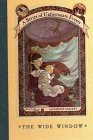
Book Review: "The Wide Window (A Series of Unfortunate Events, Book 3)" by Lemony Snicket

I'm continuing in my quest to read all 13 books in this delightful series. (Okay, I mean delightful in the sense that it makes for some entertaining reading, by no means do I mean that the poor Baudelaire orphans have delightful adventures.) Mr. Lemony Snicket (a.k.a. Daniel Handler) has just released book 13 "The End." From my recent interest in the books I'm saddened that I didn't start reading them earlier. But then again, I can now read all 13 without interruption.

The books were originally purchased for my kids and when I saw that they were as engrossed in them as they were with the Harry Potter books, I had to try them...about 6 years too late.

In this contribution to the series we find the Baudelaire orphans being sent to their Aunt Josephine, okay once again not a direct relative but their second cousin's sister-in-law, but the closest to family they have. Aunt Josephine is a great character, she's afraid of everything, including realtor's, and is a perfectionist when it comes to grammar. She has a whole library full of grammar rule books and in that same library is the "wide window" looking out on Lake Lachrymose.

Once again Count Olaf returns to take the Baudelaire fortune, this time under the guise of Captain Sham, whose business card proclaims him to be proprietor of Captain Sham's Sailboat Rentals. He flirts with Aunt Josephine enough to get through her shell and later convinces her to commit suicide and leave the children to him. Now as you may remember Count Olaf has already tried different ways to get the fortune, one by adopting them, one by trying to marry Violet (the oldest) and then by murdering Uncle Monty and threatening to take the kids to Peru.

Once again, Lemony Snicket does not allow the reader a happy ending. It always ends bad for the orphans, but the creativity in the writing and the fun characters make this book a great read. And like I say any book that gets "kids" of all ages reading it's worth checking into.

This book cemented my fandom. I was on the fence before but now, I'm a Lemony Snicket Fan.


Thursday, October 12, 2006

I will never again go to Mexico...Okay so I only went to Tijuana before, but now...

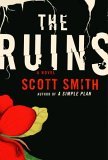
Book review: "The Ruins" by Scott Smith

I have just read one of the creepiest, scariest books since Stephen King's "The Cell," "The Ruins" by Scott Smith.

Let's start off by talking about who the author is. Scott Smith is the author of the 1993 book "A Simple Plan." And he also wrote the screenplay, which got him an Oscar Nomination. Remember that book or movie? The downfall of some folks that found lots of money? Well, after 13 years Mr. Smith has written another book that traces a different sort of downfall. This book is written balls to the wall. There aren't even any chapter breaks. Once the action starts, it is a struggle to put the book down or even to find a place to put the book down.

4 Americans (Jeff, Amy, Eric and Stacey) are on vacation in Mexico. Where they meet up with a German who speaks English (Matthias) and 3 Greeks who speak neither English nor German, but have prided themselves on adopting "Mexican" names, Pablo, Juan and Don Quixote. Matthias' brother Heinrich has taken off with a girl who is an archaelogist working on the site of some ruins. After some time Matthias worries about Heinrich and goes out to find his brother armed only with a note and a map sketched on a napkin. The Americans and One Greek, Pablo, decide to go along, after all what is Mexico without some Mayan Ruins?

The horror begins when they discover a Mayan Village and realize they must have missed the path as sketched on the map. The villagers try to ignore the party of 6 tourists but when the tourists venture onto a path that the villagers have been trying to conceal, the Mayans must become aggressive. First they try to warn the party from going onto a hill that has been overgrown with a vine with beautiful stained glass red flowers. But as soon as one steps into the vine the Mayans draw their bows and force the party to the top of the hill. All around the hill the tourists notice small mounds when they approach one of the mounds they discover the skeletal remains of Heinrich. The Mayans keep guard and do not allow the tourists off the hill under threat of death. But the tourists soon discover that death by arrow would be better than what the ruins and the vine have in store for them. The red color of the flowers is soon replaced by the constant flow of red blood.

Scott Smith, writes the book in what seems like one breath...at least I don't remember exhaling. The approach he uses is the never-turn-away-method. Once the action and gore start the author forces the reader to look closer. Such as when Pablo falls down a mine shaft and breaks his spine. We go through the process of having to lift his useless legs onto a makeshift backboard and then having to amputate his legs after they have been stripped to the bone. Or when Eric gets a glass cut after trying to help Pablo out of the mine shaft and then to discover the vine growing inside him the next morning the vines use the cut as entrance, then using a knife to carve up his own body to rid it of the vine...out of paranoia? You decide.

If you like horror, suspense, thrillers this is your book. If you are looking for a Zagat's guide to Mexico....Stay away from this book.


Wednesday, October 11, 2006

How to re-evaluate the world and your position in it.


a Book Review: "Animal Liberation" by Peter Singer

At the risk of losing many of you at the first part of this review, I will tell you this book was recommended by PETA. I have recently had my stomach and life turned by a few books about the meat processing system, and was eager to find more information. Those books were "The Jungle" by Upton Sinclair (See previous review), "Don't Eat This Book" by Morgan Spurlock, and "Fast Food Nation" by Eric Schlosser. At first I thought it would only be fast food that I'd be turned away from. But then I realized the meat packing plants don't care if they are slaughtering for home use or fast food use, all the same abuses happen.

In "Animal Liberation," Peter Singer takes us on a journey of the mind, ethics and morality. The book is broken down into 6 chapters, each independent of each other yet building on one another, so I will break this review down to a chapter by chapter review/summary.

Chapter 1. All Animals are equal...or why the ethical principle on which human equality rests requires us to extend equal consideration to animals too.

In this chapter the author presents the idea of "speciesism." This is along the lines of racism, sexism, etc. This argument is presented with simple, straightforward facts and ideas with no emotion tied to them. In fact throughout the book the author does not attempt to influence the readers way of thinking only to spur (pun intended) the thinking process. On the idea of human equality, The principle of equality is not a description of an alleged actual equality among humans: it is a prescription of how we SHOULD treat human beings. This equality should and could be carried over to "non-human" animals. Why should animals be forced to live in conditions we would not allow the lowliest of humans live in? Why should we as humans claim the right to slaughter and eat animals. Why should we as humans think that animals are there for us to pour chemicals on just to see how they react, or "condition" through painful electric shock? The author answers these questions, by saying simply. We shouldn't.

Chapter 2. Tools For Research...your taxes at work.

This chapter is one of the 2 extremely disturbing chapters which the squeamish should not only read but ask why we do these things. Or better yet allow these things to happen. I'm talking about using animals for cruel research projects. From shocking monkeys to learn how to fly a plane and then inducing radiation sickness on them to see if they can still fly with little electric shock "reminders" to pouring chemicals into bunnies eyes that we already know are irritants. In this chapter a European scientist after viewing several psychological animal experiments is quoted as calling American Scientists barbarians. The ironic part is that really, European scientists are cruel...just not as cruel as Americans. One quote that I love is that in experiments still going on now to find how much smoking contributes to lung cancer the author asks, "If people continue to smoke, knowing that by doing so they risk lung cancer, is it right to make animals suffer the cost of this decision?" The final outcome of this chapter is that animal research is completely unnecessary. For example, in guinea pigs pennicillin causes adverse effects, if we had accepted this animal research we would never had the use of that extremely useful medicine for humans.

Chapter 3. Down on the Factory Farm...or what happened to your dinner when it was still an animal.

One of the cruelest things discussed in this book is the treatment of veal cattle. These young calves are taken from their mothers (usually machine siphoned dairy cows) and kept in cages/pens which they cannot move because if they did move...the meat would not have that tender veal quality. They are also kept from having the proper nutrients because the nutrients would darken the meat. All for some snobby rich person to have their unique meat. That is just useless waste. The atrocities to other animals are also discussed. (For more on this go to my myspace site and watch the "Meet Your Meat" Video. http://www.myspace.com/gilwilson)

Chapter 4. Becoming a vegetarian...or how to produce less suffering and more food at a reduced cost to the environment.

Finally someone not only tells you why but how. And really it is just as easy as saying...leave off the meat. The main idea behind becoming a vegetarian is that in becoming a vegetarian a person would increase the amount of grain available to feed people elsewhere, reduce pollution, save water and energy, and cease contributing to the clearing of forests; moreover, since a vegetarian diet is cheaper than one based on meat dishes, they would have more money available to devote to famine relief, population control, or whatever social or political cause they thought most urgent. That's it in a nutshell. Now, keep in mind I'm not a full fledged vegetarian, but I'm working on it. I was back in college and never felt better.

Chapter 5. Man's Dominion... a history of Speciesism.

Here we go off on a tangent of how throughout times (from biblical to modern) we have denied the "non-human" animal freedom. I found this chapter to be dull but informative. It shows how throughout times humans have been cruel...but in an optimistic turn shows how views have slowly changed.

And Finally
Chapter 6. Speciesism today

Basically this shows the progress we are making...and have made in the be nice to animals campaign. Really folks it isn't hard stuff here. Why should we hunt animals for mere trophies? Why should we wear fur when synthetics are just as easily available and look just as nice?

Well what do you think?


Friday, September 29, 2006

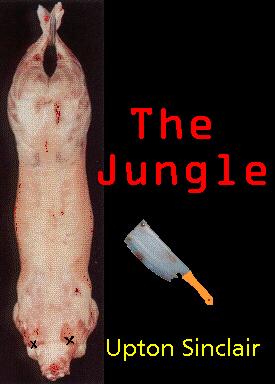
Book Review: "The Jungle" by Upton Sinclair

I read a couple of books recently that kept referring to Upton Sinclair's novel "The Jungle." Those books were "Fast Food Nation" by Eric Schlosser and "Don't Eat this Book" by Morgan Spurlock. These books were mainly books about the corruption and "unhealthiness" of the fast food industry. They all referred to the Meat packing industry where corruption still runs unchecked. "The Jungle" spurred some reaction from government when it was written because of the exposing of corruption and "unhealthiness" of the meat packing industry. The public outcry that resulted from this novel led to the 1906 Meat Inspection Act and the Pure Food and Drug Act. It also, however, led to a report issued the same year by the Department of Agriculture’s Bureau of Animal Husbandry that refuted the worst of Sinclair’s allegations. The public’s perception at this time was that the meatpacking industry feared these Acts. What was unrecognized, however, was the fact that meatpackers knew they were viewed with contempt, and facing substantial losses, the industry actually supported the Acts. They just did not want to be the ones to pay for the implementation. These Acts allayed most fears, and ironically, actually favored big business, which was the opposite of Sinclair’s intention.


Knowing that a novel could have such an impact, I had to read the book.


In "The Jungle" we follow a family of Lithuanian immigrants as they leave their country and set out to live the American Dream. Soon that dream is realized to be a nightmare. They are robbed by corrupt police upon their arrival in New York City and finally make their way to Chicago and to the stockyards where the main Character, Jurgis Rudkus has a friend that he has heard has "made it" in America. The friend runs a deli just outside of the stockyards where the families in the area all work at the stockyards. In order for any family to survive, as Jurgis finds out, all members must work, including children. They are taken on a tour of the stockyards all the way from the killing floors to the packing rooms. At first Jurgis is impressed by the speed and efficiency of the process. But once he begins work on the killing floor he sees and experiences all forms of corruption.


Jurgis and family are constantly followed by disaster, from Jurgis hurting his back and missing work to the death and disappearance of several family members. We follow Jurgis's plight as he is optimistic and willing to work to support the family, to being blacklisted from the stockyards, to "hoboing it," to a life of crime, to assisting in political graft and finally to becoming a voice for socialism.


Throughout the book nothing good ever seems to happen to Jurgis until (spoiler alert) he discovers Socialism. At this point the book becomes more of primer on Socialism and starts to become a series of philosophical discussions on the same.


Up until the discovery of Socialism the book is a heartstring tugging insight to the working man's world of the turn of the 20th century. The constant battles, struggles and disasters are enough to make the reader want to give all his earnings to the poor man. And serve as a great reminder of where this nation was 100 years ago.


I would normally tell you at this point to either enjoy the book or not to bother. It's hard to enjoy the hardships, but I think this should be a book to include in your must read list.


Friday, September 22, 2006

Book Review: "Abadazad: Book 1 -The Road to Inconceivable" by J.M. DeMatteis Illustrated by Mike Ploog.

What do you get when you cross a couple of comic book guys with a great idea for juvenile fiction? You get the latest series based book craze that'll keep the kids reading, the Abadazad series.

Before the Abadazad series found its way to book format, it had a cult following as a comic book in the comic book world. The comic that told the story of 14-year-old Kate and her search for Matty, her missing little brother who is trapped in a world with a queen with three eyes and a dream thief.

The publishers of the original comic book—CrossGen—went bankrupt and the Abadazad saga came to an end. But that ending didn't last long! Disney Publishing brought Abadazad back to life. The first two books in the series—The Road to Inconceivable and The Dream Thief—cover the original story told in the comic, but in book form.

The new Abadazad book series stays true to the original vision of the writer/artist team, D.C. Comics' J.M. DeMatteis and Shrek illustrator Mike Ploog. The first book in this series, The Road to Inconceivable, opens with Kate trying to come to terms with the disappearance of her little brother, Matty. After 5 years she still misses him, and her relationship with her mother offers no comfort. Just when Kate's about to accept that she will never see him again, meets the neighbor across the hall who has some strange stories and and "artifacts" from a mysterious world called Abadazad. After The death of her neighbor Kate receives a strange package which contains a glowing crystal ball. This ball then stransports her to Abadazad, where she finds out that her brother is being held captive. Now Kate has to make a brave choice: Risk everything she's ever known to try and find him or ... For Kate, there is no "or." The choice is easy. What follows is anything but.

I will tell you that the ages listed on the book are for 9 to 14...but since there is no time in Abadazad, I recommend you read it with your kids. I thought it was a great read. In fact, I could not put this book down and read it in one night. Now where is book 2.

To know the book it is great to know the author and illustrator. At least in this case. I'm a huge comic books fan and J.M. DeMatteis has worked on my favorite, Spider-Man, so I was drawn (pardon the pun) to this book.

Eisner Award winner J.M. DeMatteis was a professional musician and rock music journalist before entering the comic book field. He has extensive experience writing comic books where his work has won both popular and critical acclaim. His projects have ranged from Spider-Man and Superman to The Justice League. He has also received great acclaim for his groundbreaking personal visions, such as Moonshadow, Seekers Into the Mystery and the autobiographical Brooklyn Dreams. He lives with his family in upstate New York.

Mike Ploog has created art for a wide variety of comics, books and movies. He began drawing for Marvel, where he was involved in many of their best-known titles and cult favorites such as Ghost Rider, Werewolf by Night and Man-Thing. He was a designer and storyboard artist on dozens of major motion pictures—both animated and live-action—including Shrek, The Lord of the Rings, Disney's The Black Cauldron and Little Shop of Horrors. He lives and works in Devon, England.

Books #1 and #2, The Road to Inconceivable and The Dream Thief, are the first two books in this series. Book #3: The Puppet, the Professor, and the Prophet will be available March 2007. Book #4: Historcery will be available Summer 2007.

Check out their cool website abadazad.com


Thursday, September 21, 2006

Book Review: "The Power of Nice: How to Conquer the Business World with Kindness" by Linda Kaplan Thaler and Robin Koval


The idea for individuals to be nice to each other and the rewards will come has been out there for a while. There's the "teachings" of Deepak Chopra, the movie "Pay it Forward," "The Power of Positive Thinking" (although this one is more on an individual level), Chicken Soup for the Soul and Random Acts of Kindness. These are simple ways of living in which we can be nice to one another and "karma" or the universe will see to it we get our just rewards.


Well now the business world can take heed. "The Power of Nice" has a business approach to being nice that can help your business grow faster than dog-eat-dog. The authors have cited their own examples of how this has worked for them and have gathered real-life examples from others in the business world. You will read examples from Donald Trump (yes he can actually be nice) to Jay Leno.


Now, the really interesting part of this book is not the examples but they have exercises at the end of the chapters, which they call "Nice Cubes" that can help you actually put it into practice. They have also created "The Six Power of Nice Principles" which are a great way to refresh your self and your co-workers on how to be nice in the business world.


Here are the 6 Principles:


1. Positive Impressions are like seeds.

2. You never know.

3. People change.

4. Nice must be Automatic.

5. Negative Impressions are like germs.

6. You will know.


For further explanation of the principles check out this great book. You might even do good giving your boss or sales force gifts of the book.


Also check-out their Website. thepowerofnice.com